
Risks in the Supplier Risk Module
In the Platform Supplier Risk module, risk instances are vulnerabilities, exposures, and misconfigurations that have been identified on assets. Each risk instance has a detailed description, confidence level, evidence from Censys scans, and affected services.
Use risk information to pursue remediation efforts with your suppliers and update your own organization's defensive posture.
Risk categories
| Risk category | Description |
|---|---|
| Vulnerability | A vulnerability tied to a fingerprinted Common Vulnerability and Exposure (CVE) with a specific CVE ID. |
| Exposure | Services that are accessible via the public internet. They may not necessarily be vulnerable, but exposing them to the public may pose a risk. Examples include exposed SSH services and exposed API documentation. |
| Misconfiguration | Incorrect or suboptimal configuration of an information system or system component. Examples include weak authentication, lack of encryption, and invalid TLS certificates. |
Risk data
In the Platform UI, each risk instance has a score, description, confidence level, evidence from Censys scans, and affected services (on hosts). This information is shown on risk cards on assets, on risk entries in the Risks tab, and on action items.
Discovery paths for the asset associated with a risk instance are shown on risk instances on the Risks tab.
Risk data can also be retrieved via the list risk instances and list risk events API endpoints.
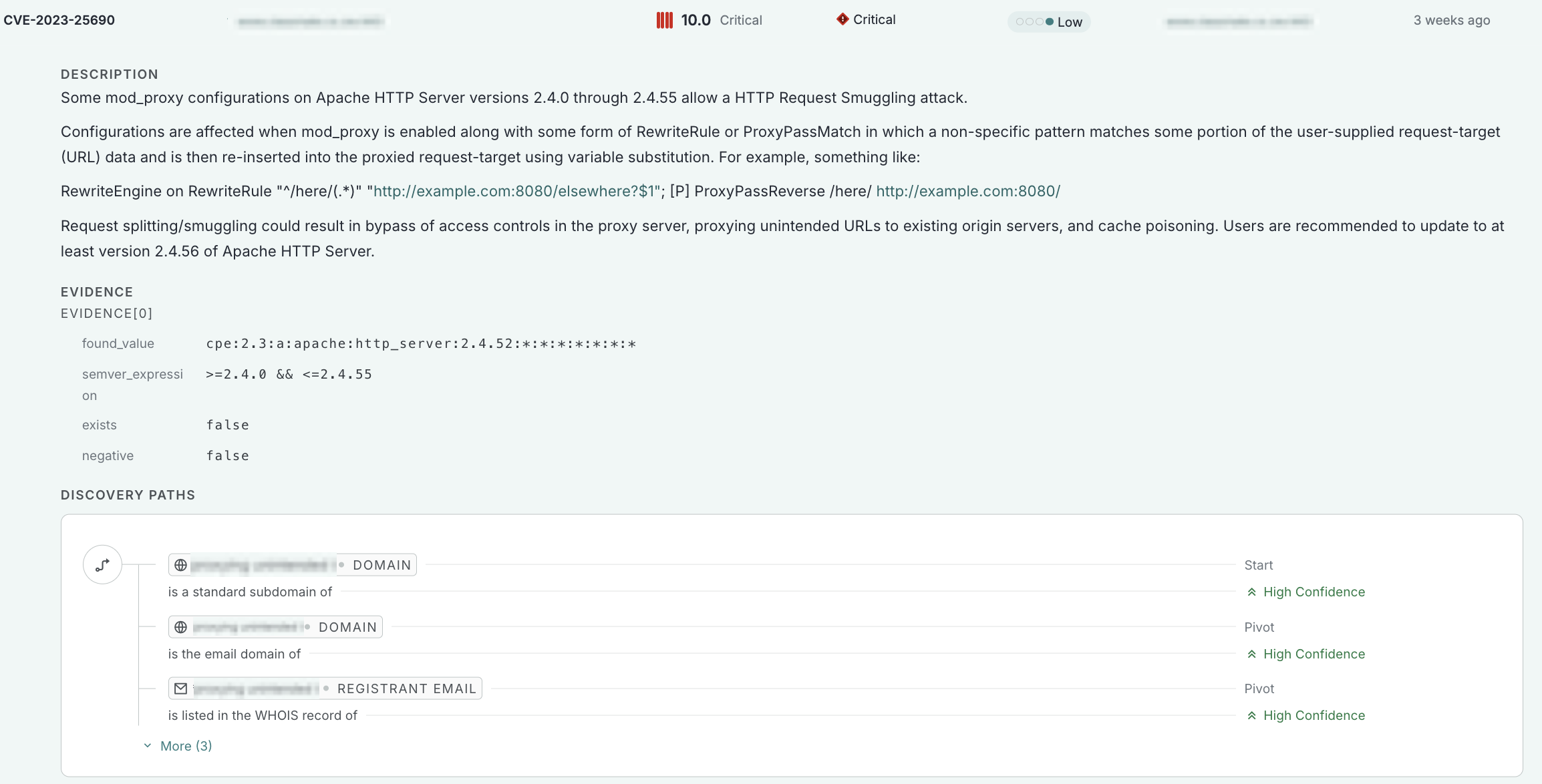
Risk instance information for a CVE identified on an example host asset.
Risk instance scores
Risk instance scores are Censys-derived metrics that incorporate asset importance, risk severity, exploitation status, and threat intelligence. Scores help you understand the severity of a risk instance using comprehensive asset and vulnerability context so you can effectively determine its remediation priority.
Risk instance score formula
Scores are determined using the following formula:
((Asset attributes + risk severity + exploitation status)/number of metrics) + additive threat variable) * 10The resulting risk score is rounded to the nearest tenth. The highest a score can be is 10. Score range severities are shown in the table below.
| Score | Severity |
|---|---|
| 7.6 to 10.0 | Critical |
| 5.1 to 7.5 | High |
| 2.6 to 5.0 | Medium |
| 0.1 to 2.5 | Low |
Asset attributes
This value defines how important an asset is to an organization. Important assets are more appealing targets to an attacker and compromising a more important asset will have greater impact on your organization. Asset importance categories and their values are shown in the table below.
| Asset importance | Value |
|---|---|
| Essential | 1 |
| Important | 0.75 |
| Moderate | 0.5 |
| Nominal | 0.25 |
| None | 0 |
The asset’s importance value is based on Censys-applied labels. The maximum value of any labels present on the asset is used for scoring purposes. For example, if an asset has two labels with the Important value and one label with the Essential value, the value used in the formula is 1.
If no labels or no mapped labels are present on an asset, then asset attributes are not factored into the final risk score.
Asset importance mapping
The following table explains which Censys labels map to asset importance levels.
| Label | Asset importance |
|---|---|
DATABASEICSMEDICAL_DEVICESCADAHYPERVISOR | Essential |
LOGIN_PAGEOPEN_DIRECTORYPRINTERPROXY_SERVER | Important |
FILE_SHARINGNETWORKFIREWALLSOHOVPNWEB_UIEMAILWAF | Moderate |
LOAD_BALANCER | Nominal |
Risk severity
The risk severity value is either applied by Censys for Censys-developed risks or derived from CVSS score for CVEs. For CVEs, the severity value is the CVSS value divided by 10.
Severity is always present on risks and is always used in score calculation.
| Severity level | Value |
|---|---|
| Critical | 1 |
| High | 0.75 |
| Medium | 0.5 |
| Low | 0.25 |
Exploitation status
Exploitation status is always used in score calculation. For CVEs, exploitability is defined based on the following:
| Exploitation status | Description | Value |
|---|---|---|
| Known Exploited | KEV, exploited in the wild. | 0.9 |
| Weaponized | Weaponized. | 0.6 |
| POC Available | Exploit POC exists. | 0.3 |
| Not documented | None of the above risk signals. | 0 |
For exposures and misconfigurations, Censys applies a set exploitation status based on extensive research.
Additive threat variable
The additive threat variable is based on whether known threat actors are associated with particular risk. Its presence or absence does not contribute to the "number of variables" value in the score calculation.
| Description | Value |
|---|---|
| 1 known threat | 0.5 |
| 2 known threats | 0.7 |
| 3 known threats | 0.9 |
| 4 or more known threats | 1 |
Number of variables
The number of variables depends on the count of the asset attribute, risk severity, and exploitation status values used for the formula. If asset attributes are not present, then the number of variables is 2. If asset attributes are present, then the number of variables is 3.
Example risk scores
The following table shows the calculation for an asset with the LOGIN_PAGE label that is affected by CVE-2020-11984.
| Asset attributes value | Risk severity value | Exploitation status value | Additive threat variable | Score |
|---|---|---|---|---|
| 0.75 (Important) | 0.98 (CVSS divided by 10) | 0.9 (KEV) | 8.8 (Critical) |
The following table shows the calculation for an asset with no mapped labels with an exposed FTP service.
| Asset attributes value | Risk severity value | Exploitation status value | Additive threat variable | Score |
|---|---|---|---|---|
| 0.75 (High, set by Censys) | 0.6 (Weaponized, set by Censys) | 6.8 (High) |
Updated 29 minutes ago